

Biodiesel Market to Reach USD 101.35 Billion by 2035, Driven by Blend Mandates and Refinery Conversions
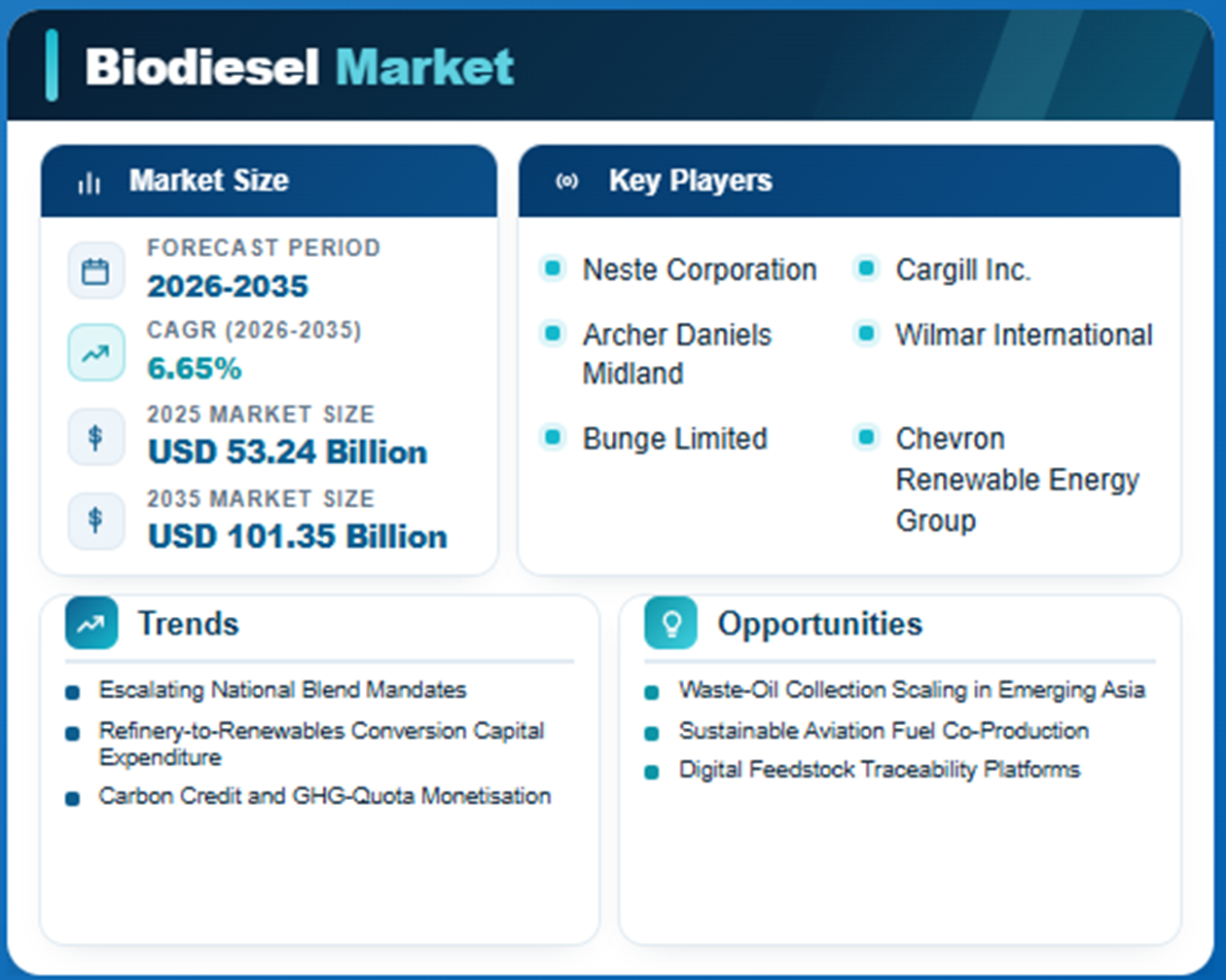
Biodiesel Market Size
Vegetable oils accounted for 58.6% of the Biodiesel Market in 2025, reflecting the dominance of palm and soybean supply chains.
Hydro-treated vegetable oil processing is advancing at a 12.72% CAGR through 2035, attracting refinery-conversion investment.
”
NEW YORK, NY, UNITED STATES, September 8, 2026 /EINPresswire.com/ -- The global Biodiesel Market reached a valuation of USD 53.24 Billion in 2025 and is projected to climb from USD 56.78 Billion in 2026 to USD 101.35 Billion by 2035, registering a compound annual growth rate of 6.65% across the forecast window. Two forces are propelling this trajectory: tightening renewable-fuel mandates in Europe and Southeast Asia, and a wave of refinery-conversion capital expenditure by integrated oil majors seeking to repurpose legacy fossil-fuel assets. Indonesia's B40 blending obligation and the European Union's revised Renewable Energy Directive III have together locked in baseline demand growth that few commodity markets can match.— Priya Nagrale
Market Overview
Biodiesel is a renewable, biodegradable fuel composed of fatty acid methyl esters (FAME) produced through the transesterification of vegetable oils, animal fats, or recycled cooking oils with an alcohol . It serves as a drop-in substitute or blending component for petroleum diesel, offering reduced greenhouse gas emissions, lower particulate matter, and improved lubricity . The market encompasses various production pathways, blend levels, and applications across transportation, industrial, and emerging marine and aviation sectors.
The market is experiencing robust growth driven by several key factors. Escalating national blend mandates are the single most powerful demand lever, with Indonesia raising its mandatory blend from B35 to B40 and requiring approximately 13.5 million kilolitres of biodiesel annually . India's National Biofuel Policy targets 5% biodiesel blending by 2028 and 10% by 2032, while Brazil's RenovaBio programme continues to expand blending requirements . The European Union's RED III framework sets binding targets that lock in baseline demand growth .
Industry trends indicate a decisive shift toward advanced production pathways. Conventional transesterification plants are gradually ceding ground to hydroprocessed vegetable oil (HVO) units capable of producing drop-in renewable diesel and sustainable aviation fuel . Shell, TotalEnergies, and Eni collectively committed over USD 6 Billion between 2023 and 2025 to expand hydroprocessing capacity, signaling that incumbents view this route as the industry's long-term backbone .
Technological developments are reshaping the market landscape. Hydroprocessing yields a paraffinic diesel indistinguishable from fossil diesel, enabling unlimited blend ratios and compatibility with existing fuel logistics . Co-processing technologies allow refineries to leverage existing petroleum assets, reducing per-unit production costs . Digital feedstock traceability platforms using blockchain-enabled mass-balance certification are emerging as competitive differentiators, allowing producers to command GHG-quota premiums of 15-20% .
Policy and regulatory influence continues to shape market dynamics. The European Union's Renewable Energy Directive III, Germany's GHG-quota system, and California's Low Carbon Fuel Standard (LCFS) all reward lower-carbon-intensity fuels with higher credit values . The EU Deforestation Regulation, effective June 2025, demands full traceability for palm-oil-based biodiesel, adding compliance costs and reshaping trade flows . The International Maritime Organization's 2023 GHG strategy and the EU's ReFuelEU Aviation mandate are opening corridors for biodiesel in marine bunkering and sustainable aviation fuel .
Europe commands a 34.8% share of the biodiesel market in 2025, underpinned by Germany's greenhouse-gas-quota system and France's TIRIB incentive framework . Asia-Pacific is the fastest-growing region, expanding at a 10.82% CAGR as India scales its national blending programme and China channels municipal waste oils into certified production. North America holds the second-largest share at 24.2%, driven by the U.S. Renewable Fuel Standard and California's LCFS .
Get Free Sample Report for Detailed Market Insights:
https://www.marketresearchfuture.com/sample_request/1521
Market Segmentation
By Feedstock
Vegetable Oils: Accounted for 58.6% of the market in 2025, reflecting the dominance of palm, soybean, and rapeseed supply chains
Waste Cooking Oil and Tallow: Fastest-growing feedstock category at 10.91% CAGR through 2035, driven by circular-economy mandates and carbon-intensity premiums
Other Feedstocks: Includes jatropha, algae, tall oil, and lignocellulosic biomass niche applications
By Production Process
Trans-Esterification: Held a 65.2% share in 2025, remaining the most widely deployed conversion pathway with lower capital intensity
Hydro-Treated Vegetable Oil: Advancing at a 12.72% CAGR through 2035, attracting refinery-conversion investment for drop-in fuel quality
Co-Processed/Co-Refined Diesel: Leveraging existing petroleum refinery assets for renewable fuel production
By Blend Level
B5 and Below: Led with a 44.2% share in 2025, serving as the default compliance blend in early-mandate markets
B6 to B20: Capturing the bulk of mandate-driven growth in Europe and Latin America
B100: Fastest-expanding blend tier at 11.74% CAGR, driven by captive fleet operators and industrial boiler users
By Application
Transportation-Road: Retained a 63.2% share in 2025, absorbing the vast majority of mandated and voluntary blending volumes
Industrial and Others: Expanding at 13.52% CAGR, led by marine bunkering, stationary power, and mining applications
Sustainable Aviation Fuel: Emerging high-value application derived from biodiesel feedstocks, creating premium market opportunities
You can buy this market report at:
https://www.marketresearchfuture.com/checkout?currency=one_user-USD&report_id=1521
Regional Analysis
Europe
Europe commands a 34.8% share of the biodiesel market, anchored by Germany's GHG-quota system and France's TIRIB incentive framework . Germany's annually escalating GHG-reduction quota—targeting 25% reduction by 2030—ensures predictable demand . The Nordic cluster, led by Neste's Porvoo and Rotterdam facilities, has positioned the region as a global hub for advanced renewable-diesel refining . The UK's RTFO certificate scheme and Italy's Eni biorefinery programme contribute to regional leadership. The EU Deforestation Regulation, effective June 2025, is redirecting European buyers toward rapeseed and waste oils over tropical palm feedstocks .
Asia-Pacific
Asia-Pacific is the fastest-growing region at a 10.82% CAGR through 2035, with Indonesia, India, and China driving volumes . Indonesia alone consumed over 11 million kilolitres of biodiesel in 2024 under its B35 mandate, with B40 enacted for 2025 . India's National Biofuel Policy targets 5% biodiesel blending by 2028 and 10% by 2032, creating incremental demand of 3.2 million tonnes per year by 2028 . China's rapidly expanding waste-oil collection and export-refining infrastructure has turned the country into the world's largest UCO-biodiesel exporter, with shipments exceeding 3 million tonnes in 2024 .
North America
North America holds the second-largest share at 24.2%, driven by the U.S. Renewable Fuel Standard and California's LCFS . The U.S. remains the dominant consumer, with EPA Renewable Volume Obligations exceeding 3 billion gallons of biomass-based diesel in 2024 . California's LCFS credit price—trading above USD 60 per tonne of CO₂e in late 2024—provides an additional revenue stream . Canada's Clean Fuel Regulations add a parallel compliance demand for low-carbon fuels . Phillips 66 converted its Rodeo facility in California to 800 million gallons per year of renewable fuels by mid-2024 .
South America
Brazil anchors the South American market, with its RenovaBio programme generating over 37 million decarbonisation credits (CBIOs) in 2024 . Brazil's integrated soybean-crushing and biodiesel production chain positions the country as the hemisphere's largest producer. Argentina's idle soybean-crushing capacity can be redirected toward biodiesel exports as EU demand shifts away from Southeast Asia .
Middle East & Africa
The region's market remains nascent, constrained by abundant domestic fossil-fuel supply. South Africa's Industrial Biofuels Strategy, targeting 400 million litres of annual production, represents the most structured policy effort . Saudi Arabia's Vision 2030 and the UAE's sustainability-linked refining pilots signal growing interest, though full-scale deployment remains limited .
Competitive Landscape / Key Players
The biodiesel market exhibits low concentration, with the top five producers collectively holding an estimated 22-28% of global revenue. Competition increasingly hinges on feedstock-sourcing resilience, carbon-intensity certification, and multi-product refinery flexibility .
Neste Corporation (~5-8% revenue share): Global HVO leader with vertically integrated waste-feedstock sourcing and the world's largest single-site HVO plant in Singapore .
Cargill Inc. (~3-5%): Leverages commodity-trading scale and origination networks for soybean and canola FAME production .
Archer Daniels Midland (ADM) (~3-5%): Integrated oilseed processing and logistics for soybean FAME and glycerine co-products .
Wilmar International (~3-5%): Southeast Asian feedstock dominance through palm-based biodiesel and oleochemicals .
Bunge Limited (~2-4%): Americas production and export infrastructure for soybean FAME .
Other notable players include Louis Dreyfus Company, Chevron Renewable Energy Group, TotalEnergies SE, Eni S.p.A., and VERBIO Vereinigte BioEnergie AG.
Latest Industry News & Developments
Neste Corporation (March 2025): Completed the expansion of its Singapore renewable-products refinery to 1.3 million tonnes per year, making it the world's largest single-site HVO plant .
Chevron, Restaurant Technologies, and Sheetz (September 2024): Created a circular economy by recycling used cooking oil into biodiesel, reducing waste and lowering lifecycle carbon emissions .
Indonesia Ministry of Energy (September 2024): Officially enacted the B40 blending mandate effective January 2025, requiring all diesel fuel sold domestically to contain 40% palm-biodiesel .
European Commission (June 2024): Published delegated acts under RED III specifying eligible feedstocks and double-counting criteria for waste-based biodiesel, setting the regulatory framework through 2030 .
Indian Ministry of Petroleum (February 2024): Released the revised National Biofuel Policy roadmap targeting 5% biodiesel blending in high-speed diesel by 2028 and 10% by 2032 .
Market Challenges & Opportunities
Key Restraints
Feedstock price volatility and palm-oil supply risk remain significant challenges, with crude palm oil futures exceeding USD 1,500 per tonne during the 2022-2023 spike . Anti-deforestation regulations, including the EU Deforestation Regulation effective June 2025, demand full traceability for palm-oil-based biodiesel, adding EUR 30-50 per tonne in compliance costs . Feedstock costs account for 60-80% of total production expenses, making producers vulnerable to agricultural commodity fluctuations . Fossil-diesel price deflation reduces blending economics, while grid-electrification displaces liquid-fuel demand in light vehicles .
Emerging Opportunities
Waste-oil collection scaling in emerging Asia could unleash an extra 4 million tonnes per year of low-carbon feedstock by 2030, reducing reliance on virgin oils . Sustainable aviation fuel co-production through flexible distillation columns secures premium off-take contracts, with ReFuelEU mandating 2% SAF blending from 2025 . Digital feedstock traceability platforms offering real-time carbon-intensity scores command GHG-quota premiums of 15-20%. Latin American capacity expansion through Brazil's RenovaBio programme and Argentina's idle soybean-crushing capacity offers growth potential . Marine bunkering and industrial heat applications represent structural demand floors, with the IMO's 2030 checkpoint channelling vessel operators toward ISCC-certified biodiesel blends .
Future Potential
Feedstock diversification toward waste and residue sources could supply up to 40% of global biodiesel input by 2035, reducing land-use competition by 50-60% relative to palm-oil pathways . Digitalisation of supply chains through AI-driven blending optimisation and IoT-connected collection points will embed digital infrastructure into the value chain . Policy convergence toward carbon-intensity standards across California's LCFS, the EU's GHG-quota system, and Canada's Clean Fuel Regulations will incentivise process efficiency and waste-feedstock sourcing. Integration with sustainable aviation and marine fuel markets will create multi-product flexibility, with SAF demand alone potentially reaching 15 billion litres by 2035.
To explore more market insights, visit us at:
https://www.marketresearchfuture.com/reports/biodiesel-market-1521
Final Market Summary
The global Biodiesel Market is positioned for sustained growth, with projections indicating expansion from USD 56.78 billion in 2026 to USD 101.35 billion by 2035, registering a 6.65% CAGR. Market dynamics are driven by the convergence of escalating blend mandates, refinery-conversion capital expenditure, and carbon-credit monetisation. The shift from conventional transesterification to advanced hydroprocessing and multi-product refinery architectures is transforming the market landscape.
Europe commands a 34.8% share, anchored by Germany's GHG-quota system and France's TIRIB framework, while Asia-Pacific delivers the fastest regional growth at 10.82% CAGR driven by Indonesia's B40 mandate and India's blending targets. North America holds 24.2%, supported by RFS compliance and LCFS credits. While challenges including feedstock price volatility and regulatory complexity persist, the long-term industry outlook remains robust, supported by the essential role of biodiesel in enabling transport decarbonisation, energy security, and circular economy objectives. The decade ahead will reward producers who combine feedstock diversification, carbon-intensity optimisation, and digital traceability to capture value across road, marine, and aviation fuel pools.
More Related Reports from MRFR Library:
india industrial boilers Market: https://www.marketresearchfuture.com/reports/india-industrial-boilers-market-54273
combined cycle gas turbine Market: https://www.marketresearchfuture.com/reports/combined-cycle-gas-turbine-market-33228
india energy storage Market: https://www.marketresearchfuture.com/reports/india-energy-storage-market-48619
valves in the oil gas Market: https://www.marketresearchfuture.com/reports/valves-in-the-oil-gas-market-23302
underground natural gas storage Market: https://www.marketresearchfuture.com/reports/underground-natural-gas-storage-market-10944
copper magnet wire Market: https://www.marketresearchfuture.com/reports/copper-magnet-wire-market-25283
power generation gas turbine Market: https://www.marketresearchfuture.com/reports/power-generation-gas-turbine-market-28764
hot briquetted iron Market: https://www.marketresearchfuture.com/reports/hot-briquetted-iron-market-25267
ancillary services Market: https://www.marketresearchfuture.com/reports/ancillary-services-market-65900
ring main unit Market: https://www.marketresearchfuture.com/reports/ring-main-unit-market-2802
Market Research Future
Market Research Future
+1 855-661-4441
email us here
Legal Disclaimer:
EIN Presswire provides this news content "as is" without warranty of any kind. We do not accept any responsibility or liability for the accuracy, content, images, videos, licenses, completeness, legality, or reliability of the information contained in this article. If you have any complaints or copyright issues related to this article, kindly contact the author above.
