

Study: Happiest Employees Report More Stress Than Struggling Colleagues
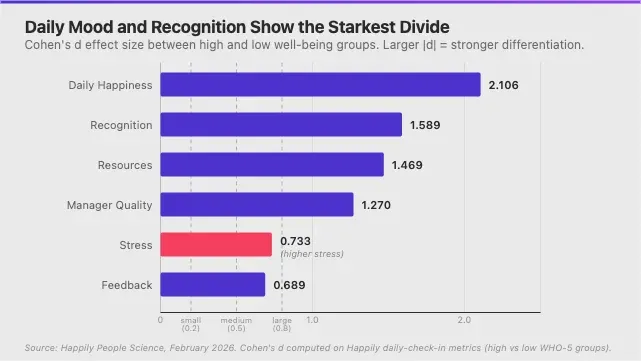
Workplace factors ranked by effect size: Recognition (d=1.59) strongest, Feedback (d=0.69) weakest. Source: Happily.ai, 65,626 WHO-5 responses.
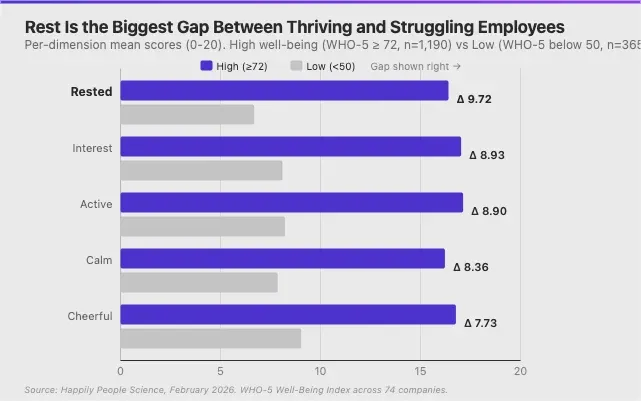
Gap between high and low well-being groups across 5 WHO-5 dimensions. Rest shows the largest gap. Source: Happily.ai, 2,912 employees.
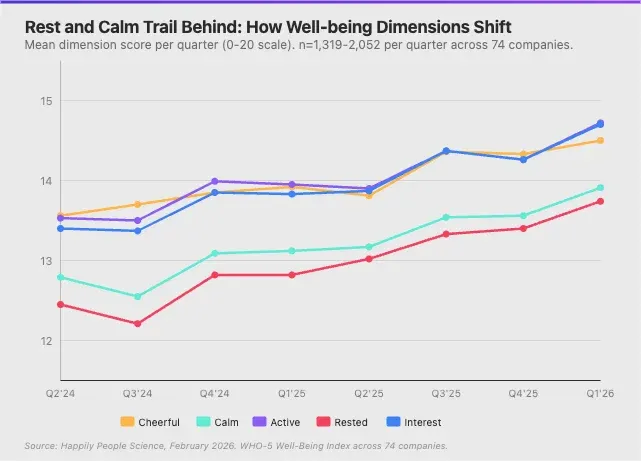
WHO-5 well-being dimensions tracked quarterly from April 2024 to January 2026. Rest consistently ranks lowest. Source: Happily.ai, 74 companies.
Analysis of 65,626 well-being responses from 2,912 employees reveals stress reduction may be the wrong intervention
Employees scoring 72 or above on the WHO-5 (the clinically validated well-being index developed by the World Health Organization) reported average stress levels of 1.71 on a 0-4 scale, compared to just 1.27 for those scoring below 50. The effect size (Cohen's d = 0.73) qualifies as a large effect in social science research. The most likely explanation: high-well-being employees are engaged in demanding, visible work that creates productive tension, while low-well-being employees experience lower stress through withdrawal, not peace.
"Organizations are spending on stress reduction when the real bottleneck is recovery," said Tareef Jafferi, Founder and CEO of Happily.ai. "Our data shows employees maintain cheerfulness even when their rest and calm have collapsed. By the time someone looks unhappy, the damage is months old."
Recognition Outperforms Every Other Workplace Factor — Including Feedback
The analysis tracked five WHO-5 dimensions quarterly over two years (April 2024 to January 2026) across 74 companies and 2,912 employees, generating 65,626 individual responses. "Feeling rested" ranked as the lowest dimension in all eight quarters studied, never exceeding 13.74 out of 20.
When researchers compared the six workplace factors that differentiate high and low well-being groups, the ranking contradicted where companies direct their wellness spending. Recognition had the strongest effect size (d=1.59), followed by resource adequacy (d=1.47) and manager quality (d=1.27). Feedback — the intervention companies invest most heavily in, through structured reviews, 360-degree assessments, and continuous feedback tools — showed the weakest effect of any factor measured (d=0.69).
The implication is direct: organizations have built feedback infrastructures on the assumption that communication and input drive well-being. The data says the workforce is more moved by feeling seen and having what it needs to do the job than by receiving more input on its performance.
"Companies have been building stress-reduction programs when employees need recovery infrastructure," said Jafferi. "Gym memberships, meditation apps, and mindfulness stipends don't address 'feeling rested.' Protecting recovery means structural decisions: meeting load, calendar norms, recovery time built into workflow. It's an operations problem, not a wellness program problem."
Implications for HR Leaders and CEOs
The findings point to three practical shifts for organizations evaluating their wellness spending. First, recognition programs should be treated as a health intervention, not a culture perk — the effect size rivals any clinical workplace intervention in this dataset. Second, "feeling rested" as a tracked metric deserves the same leadership attention as productivity KPIs; its persistent ranking as the lowest dimension across eight consecutive quarters indicates a systemic gap, not an individual preference. Third, the feedback-well-being correlation being the weakest measured should prompt a review of whether feedback volume is being conflated with employee health, and whether that investment is crowding out higher-ROI alternatives.
Anyone can take the WHO-5 assessment and compare their results against the 2,912-person benchmark at https://research.happily.ai/well-being/. The full research is available at https://happily.ai/blog/who5-dimensions-employee-wellbeing/.
About the Research
This study used the WHO-5 Well-Being Index, a five-item clinically validated instrument developed by the World Health Organization and widely used in international health research and primary care screening. The dataset comprised 65,626 responses from 2,912 employees across 74 companies, collected quarterly from April 2024 through January 2026 — eight measurement periods in total. Five well-being dimensions were tracked: cheerfulness, calmness, vigor, rest, and interest in daily life. Workplace factor analysis used Cohen's d to measure effect size when comparing employees with WHO-5 scores of 72 or above (high well-being group) against those scoring below 50 (low well-being group). Effect sizes of 0.8 or above are conventionally classified as large in social science research; recognition (d=1.59), resource adequacy (d=1.47), and manager quality (d=1.27) all exceeded this threshold.
About Happily.ai
Happily.ai is a Culture Activation platform that transforms organizational culture through daily behavioral change rather than periodic measurement. Built on behavioral science and gamification, the platform achieves 97% adoption (vs. 25% industry average) by making participation intrinsically rewarding. CEOs get continuous visibility into team health, alignment, and goal progress. Clients experience 48-point eNPS improvements, 40% reductions in turnover, and $480K in annual savings per 100 employees.
Learn more at https://happily.ai
Tareef Jafferi
Happily.ai
+66 83 689 5235
tareef@happily.ai
Legal Disclaimer:
EIN Presswire provides this news content "as is" without warranty of any kind. We do not accept any responsibility or liability for the accuracy, content, images, videos, licenses, completeness, legality, or reliability of the information contained in this article. If you have any complaints or copyright issues related to this article, kindly contact the author above.
