

Energy Storage For Unmanned Aerial Vehicles Market 2026 Powering Next-Gen Drones
Energy Storage For Unmanned Aerial Vehicles (UAVs) Market Growth

Energy Storage For Unmanned Aerial Vehicles (UAVs) Market Growth
Energy Storage For Unmanned Aerial Vehicles (UAVs) Market Forecast
The Business Research Company’s Energy Storage For Unmanned Aerial Vehicles Global Market Report 2026 - Market Size, Trends, And Global Forecast 2026-2035
LONDON, GREATER LONDON, UNITED KINGDOM, March 17, 2026 /EINPresswire.com/ -- Energy Storage For Unmanned Aerial Vehicles (UAVs) Market to Surpass $5 billion in 2030. In comparison, the Defense market, which is considered as its parent market, is expected to be approximately $724 billion by 2030, with Energy Storage For Unmanned Aerial Vehicles (UAVs) to represent around 1% of the parent market. Within the broader Aerospace And Defense industry, which is expected to be $1,166 billion by 2030, the Energy Storage For Unmanned Aerial Vehicles (UAVs) market is estimated to account for nearly 0.4% of the total market value.
Which Will Be the Biggest Region in the Energy Storage For Unmanned Aerial Vehicles (UAVs) Market in 2030?
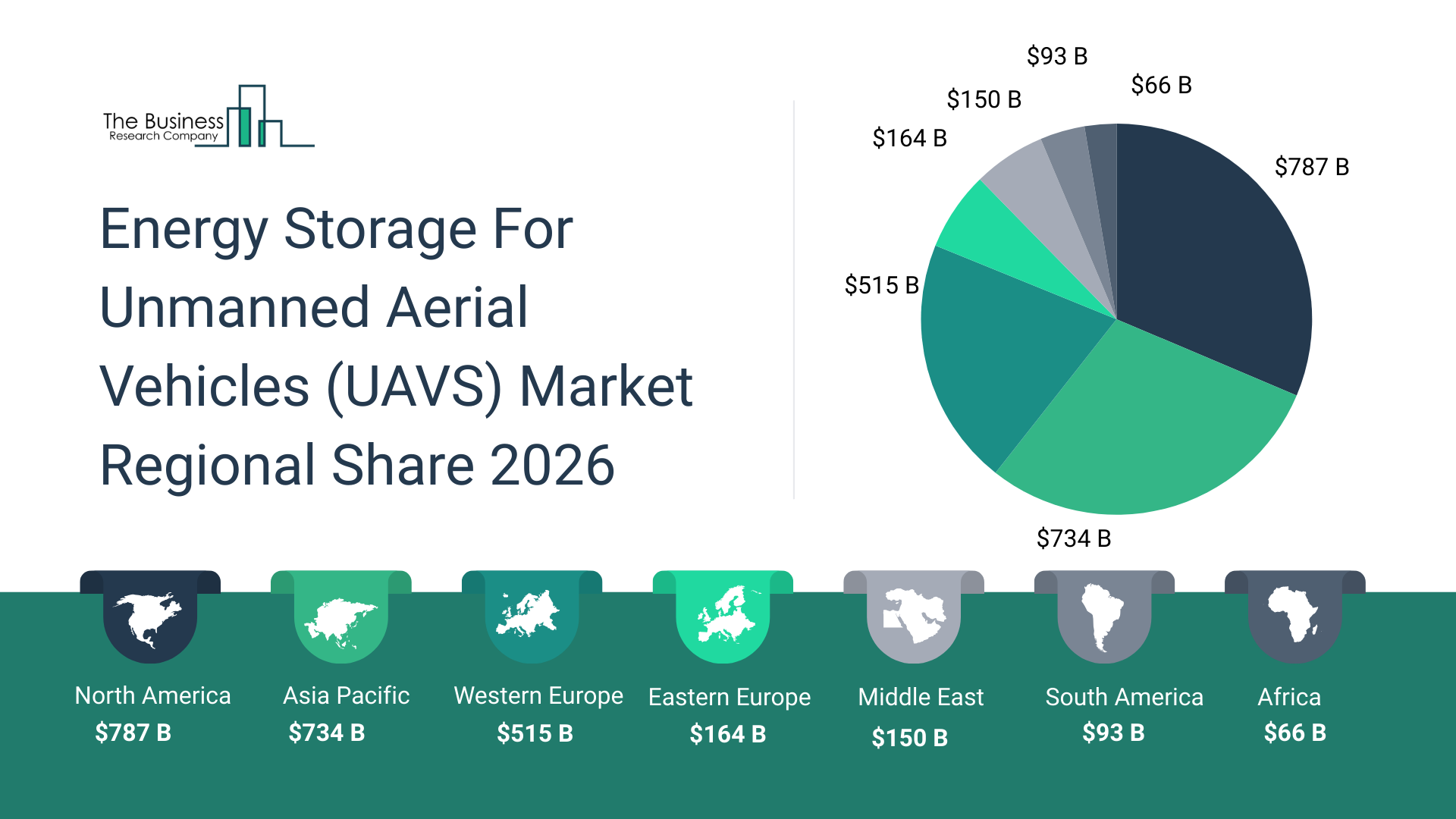
Asia Pacific will be the largest region in the energy storage for unmanned aerial vehicles (UAVs) market in 2030, valued at $1,571 million. The market is expected to grow from $604 million in 2025 at a compound annual growth rate (CAGR) of 21%. The exponential growth can be attributed to the rising incorporation of unmanned aerial vehicles (UAVs) in precision agriculture and rising demand for commercial drones.
Which Will Be The Largest Country In The Global Energy Storage For Unmanned Aerial Vehicles (UAVs) Market In 2030?
The USA will be the largest country in the energy storage for unmanned aerial vehicles (UAVs) market in 2030, valued at $1,210 million. The market is expected to grow from $598 million in 2025 at a compound annual growth rate (CAGR) of 15%. The rapid growth can be attributed to the rising advancements in battery technologies and increasing product launches.
Request a free sample of the Energy Storage For Unmanned Aerial Vehicles (UAVs) Market report:
https://www.thebusinessresearchcompany.com/sample_request?id=27734&type=smp&utm_source=EINPresswire&utm_medium=Paid&utm_campaign=Mar_PR
What will be Largest Segment in the Energy Storage For Unmanned Aerial Vehicles (UAVs) Market in 2030?
The energy storage for unmanned aerial vehicles (UAVs) market is segmented by type into lithium-ion batteries, lead-acid batteries, nickel-metal hydride batteries, solid state batteries and ultracapacitors. The lithium-ion batteries market will be the largest segment of the energy storage for unmanned aerial vehicles (UAVs) market segmented by type, accounting for 82% or $4,107 million of the total in 2030. The lithium-ion batteries market will be supported by high gravimetric energy density enabling longer flight endurance, strong demand for lightweight power systems in small and medium drones, widespread acceptance across defense and commercial fleets, declining cost per watt-hour improving procurement economics, strong recharge efficiency supporting high sortie rates, suitability for modular battery pack designs and compatibility with existing UAV power management architectures.
The energy storage for unmanned aerial vehicles (UAVs) market is segmented by product into battery and fuel cell. The battery market will be the largest segment of the energy storage for unmanned aerial vehicles (UAVs) market segmented by product, accounting for 88% or $4,420 million of the total in 2030. The battery market will be supported by widespread standardization across UAV platforms, ease of integration with existing airframes, scalability across payload classes, high availability through OEM supply networks, suitability for both rotary and fixed-wing drones, predictable maintenance cycles and strong acceptance across defense, commercial and civil applications.
The energy storage for unmanned aerial vehicles (UAVs) market is segmented by capacity into 0-10 kilowatt-hour, 10-50 kilowatt-hour, 50-100 kilowatt-hour, 100- 200 kilowatt-hour and greater than 200 kilowatt-hour. The 0-10 kilowatt-hour market will be the largest segment of the data energy storage for unmanned aerial vehicles (UAVs) market segmented by capacity, accounting for 60% or $2,987 million of the total in 2030. The 0-10 kilowatt-hour market will be supported by high demand for small consumer and commercial drones, widespread use in photography and inspection platforms, lower regulatory barriers for lightweight UAVs, cost efficiency for short-duration missions, rapid battery replacement cycles, compatibility with urban operations and strong adoption among startups and service providers.
The energy storage for unmanned aerial vehicles (UAVs) market is segmented by distribution into original equipment manufacturers (OEMs), aftermarket sales, direct sales, specialized integrators and online retailers. The original equipment manufacturers (OEMs) market will be the largest segment of the data energy storage for unmanned aerial vehicles (UAVs) market segmented by distribution, accounting for 54% or $2,686 million of the total in 2030. The original equipment manufacturers (OEMs) market will be supported by integrated design control, optimized power-to-weight ratios, long-term supply agreements, stringent quality assurance standards, direct alignment with airframe development, compliance with aviation certifications and preference from defense and enterprise customers.
The energy storage for unmanned aerial vehicles (UAVs) market is segmented by application into military and defense, commercial logistics and delivery, agriculture and forestry, infrastructure inspection and monitoring and entertainment and media. The military and defense market will be the largest segment of the data energy storage for unmanned aerial vehicles (UAVs) market segmented by application, accounting for 42% or $2,120 million of the total in 2030. The military and defense market will be supported by increasing reliance on unmanned reconnaissance, demand for persistent surveillance, reduction of pilot risk, modernization of armed forces, border security requirements, strategic intelligence gathering and rising defense budgets globally.
What is the expected CAGR for the Energy Storage For Unmanned Aerial Vehicles (UAVs) Market leading up to 2030?
The expected CAGR for the energy storage for unmanned aerial vehicles (UAVs) market leading up to 2030 is 19%.
What Will Be The Growth Driving Factors In The Global Energy Storage For Unmanned Aerial Vehicles (UAVs) Market In The Forecast Period?
The rapid growth of the global energy storage for unmanned aerial vehicles (UAVs) market leading up to 2030 will be driven by the following key factors that are expected to reshape drone endurance capabilities, mission efficiency, and next-generation aerial mobility applications worldwide.
Rising Demand For Commercial Drones - The rising demand for commercial drones will become a key driver of growth in the energy storage for unmanned aerial vehicles (UAVs) market by 2030. As enterprises and industries increasingly deploy commercial drones across applications such as agriculture, logistics, infrastructure inspection, and aerial monitoring, the expanding use of UAV platforms drives the need for advanced energy storage systems capable of supporting longer flight durations, higher payloads, and more frequent operations. Industry projections indicate that the global commercial drone fleet is expanding rapidly year on year, reflecting a broader shift toward automation, precision operations, and cost-efficient aerial solutions across multiple sectors. As organizations deploy larger numbers of commercial drones and expand mission complexity and operational scale, the demand for high-performance, reliable, and efficient battery technologies becomes critical to ensure endurance, productivity, and operational continuity, thereby significantly driving the growth of the energy storage for unmanned aerial vehicles (UAVs) market. As a result, rising demand for commercial drones is anticipated to contributing to a 1.6% annual growth in the market.
Rise In Advancements In Battery Technologies - The rise in advancements in battery technologies will emerge as a major factor driving the expansion of the energy storage for unmanned aerial vehicles (UAVs) market by 2030. As research and development in battery chemistries, cell architectures, and manufacturing processes accelerate, next-generation energy storage solutions are delivering higher energy density, improved safety, faster charging, and longer cycle life, capabilities that are increasingly critical for UAV platforms operating across commercial, industrial, and defense applications. Industry analysis indicates that the global battery industry has entered a new phase characterized by innovation in solid-state cells, silicon-enhanced anodes, and scalable production techniques, reflecting a broader shift toward more efficient, durable, and cost-effective energy storage systems. As organizations integrate these advanced battery technologies into UAV designs to support extended flight durations, heavier payloads, and more demanding mission profiles, the demand for high-performance energy storage solutions will become essential to meet evolving operational expectations, thereby significantly driving the growth of the energy storage for unmanned aerial vehicles (UAVs) market. Consequently, the rise in advancements in battery technologies is projected to contributing to a 1.4% annual growth in the market.
Enhanced Payload And Performance Requirements - The enhanced payload and performance requirements will serve as a key growth catalyst for the energy storage for unmanned aerial vehicles (UAVs) market by 2030. As UAV operators increasingly demand drones capable of carrying heavier sensors, extended-range equipment, and multifunctional payloads for applications such as mapping, surveillance, delivery, and industrial inspection, the need for more capable and efficient energy storage systems becomes critical to support these higher performance standards. Research indicates that higher payload capacities and expanded mission capabilities are key drivers of UAV utilization across commercial and defense sectors, reflecting a broader trend toward multipurpose aerial platforms that require longer flight endurance and greater power delivery. As organizations pursue advanced UAV applications that push the limits of flight time, operational range, and mission complexity, the adoption of advanced battery technologies and high-density energy storage solutions will become essential to meet these requirements, thereby significantly driving the growth of the energy storage for unmanned aerial vehicles (UAVs) market. Therefore, this enhanced payload and performance requirements is projected to supporting to a 1.1% annual growth in the market.
Rising Incorporation Of UAVs In Precision Agriculture - The rising incorporation of UAVs in precision agriculture will become a significant driver contributing to the growth of energy storage for unmanned aerial vehicles (UAVs) market by 2030. As agricultural producers and farm management firms increasingly adopt precision farming practices to optimize input use, enhance crop yields, and support sustainable operations, unmanned aerial vehicles are being deployed to collect high-resolution field data, monitor crop health, and enable targeted interventions such as variable-rate spraying and resource application. Industry trends indicate that UAVs are becoming essential tools in modern precision agriculture due to their ability to perform rapid field scouting, multispectral imaging, and real-time decision support that drive efficiency and reduce resource waste on farms worldwide. As more agricultural operations integrate UAVs into their precision agriculture strategies to support data-driven crop management and maximize productivity, the demand for advanced, high-performance energy storage systems that enable longer flight durations, robust endurance, and reliable operation will become increasingly critical, thereby significantly driving growth in the energy storage for unmanned aerial vehicles (UAVs) market. Consequently, the rising incorporation of UAVs in precision agriculture is projected to contributing to a 0.9% annual growth in the market.
Access the detailed Energy Storage For Unmanned Aerial Vehicles (UAVs) Market report here:
https://www.thebusinessresearchcompany.com/report/energy-storage-for-unmanned-aerial-vehicles-uavs-global-market-report?utm_source=EINPresswire&utm_medium=Paid&utm_campaign=Mar_PR
What Are The Key Growth Opportunities In The Energy Storage For Unmanned Aerial Vehicles (UAVs) Market in 2030?
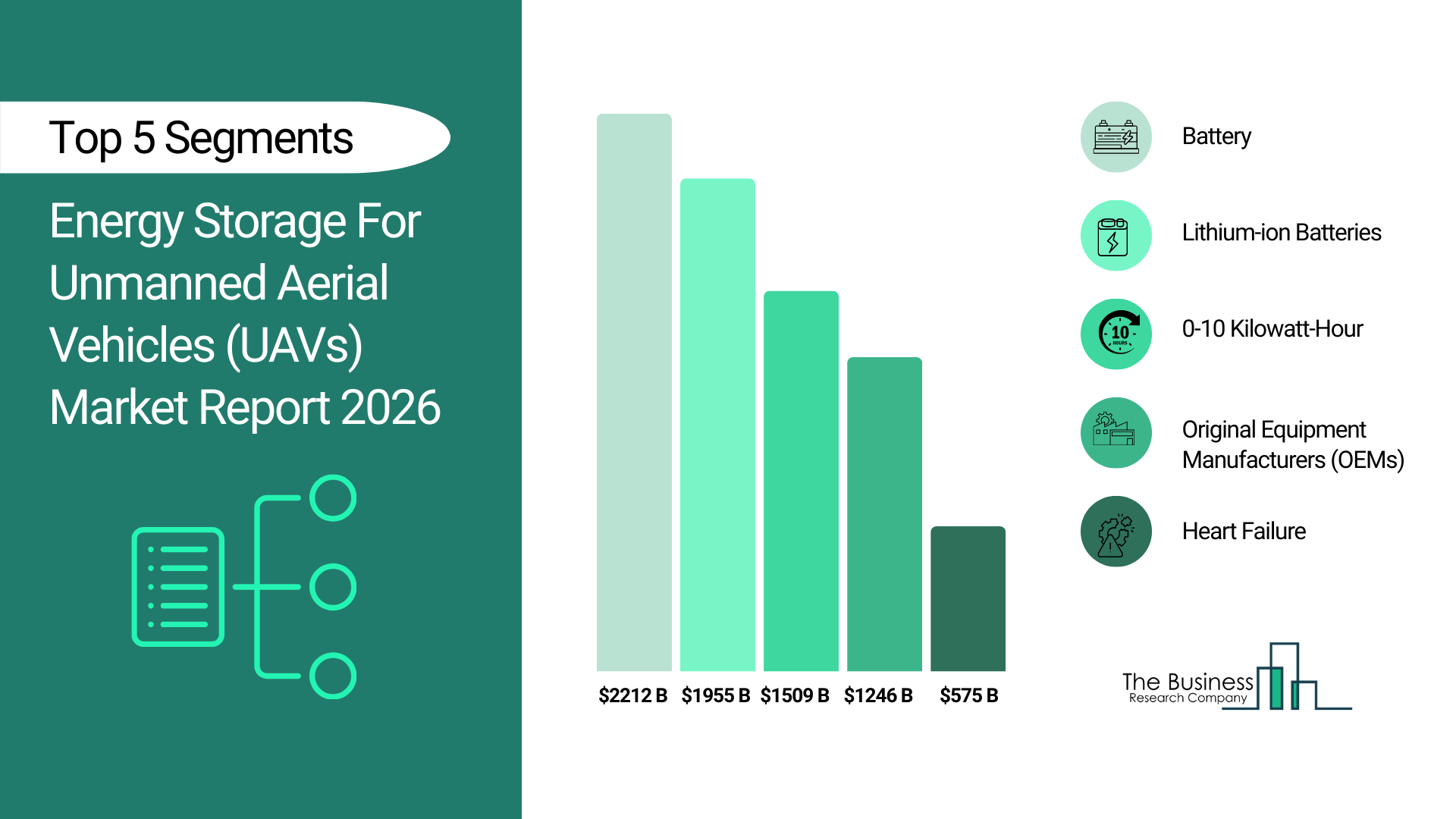
The most significant growth opportunities are anticipated in the battery energy storage for unmanned aerial vehicles (UAVs) market, the lithium-ion batteries for unmanned aerial vehicles (UAVs) market, the 0-10 kilowatt-hour energy storage for unmanned aerial vehicles (UAVs) market, the energy storage for original equipment manufacturers (OEMs) market, and the energy storage for military and defense market. Collectively, these segments are projected to contribute over $10 billion in market value by 2030, driven by increasing deployment of UAVs across commercial and defense sectors, advancements in high-energy-density and lightweight lithium-ion battery technologies, and growing demand for extended flight endurance and mission reliability. This surge reflects the accelerating reliance on advanced energy storage systems that enable longer operational ranges, improved payload efficiency, rapid recharge capabilities, and enhanced safety performance, ultimately fueling transformative growth within the broader UAV energy storage industry.
The battery energy storage for unmanned aerial vehicles (UAVs) market is projected to grow by $2,563 million, the lithium-ion batteries for unmanned aerial vehicles (UAVs) market by $2,493 million, the 0-10 kilowatt-hour energy storage for unmanned aerial vehicles (UAVs) market by $1,718 million, the energy storage for original equipment manufacturers (OEMs) market by $1,661 million, and the energy storage for military and defense market by $1,211 million over the next five years from 2025 to 2030.
The Business Research Company (www.thebusinessresearchcompany.com) is a leading market intelligence firm renowned for its expertise in company, market, and consumer research. We have published over 17,500 reports across 27 industries and 60+ geographies. Our research is powered by 1,500,000 datasets, extensive secondary research, and exclusive insights from interviews with industry leaders.
We provide continuous and custom research services, offering a range of specialized packages tailored to your needs, including Market Entry Research Package, Competitor Tracking Package, Supplier & Distributor Package and much more
Disclaimer: Please note that the findings, conclusions and recommendations that TBRC Business Research Pvt Ltd delivers are based on information gathered in good faith from both primary and secondary sources, whose accuracy we are not always in a position to guarantee. As such TBRC Business Research Pvt Ltd can accept no liability whatever for actions taken based on any information that may subsequently prove to be incorrect. Analysis and findings included in TBRC reports and presentations are our estimates, opinions and are not intended as statements of fact or investment guidance.
The Business Research Company
Americas +1 310-496-7795
Europe +44 7882 955267
Asia & Others +44 7882 955267 & +91 8897263534
Email: info@tbrc.info
Oliver Guirdham
The Business Research Company
+44 7882 955267
info@tbrc.info
Visit us on social media:
LinkedIn
Facebook
X
Legal Disclaimer:
EIN Presswire provides this news content "as is" without warranty of any kind. We do not accept any responsibility or liability for the accuracy, content, images, videos, licenses, completeness, legality, or reliability of the information contained in this article. If you have any complaints or copyright issues related to this article, kindly contact the author above.
