

Smart Sensors Market to Surge to US$ 187 Bn by 2032: Trends, Drivers, and Opportunities
Smart Sensors Market Share
Global smart sensors market to reach US$187.2 Bn by 2032, driven by IoT growth, automation, and rising demand for intelligent monitoring solutions
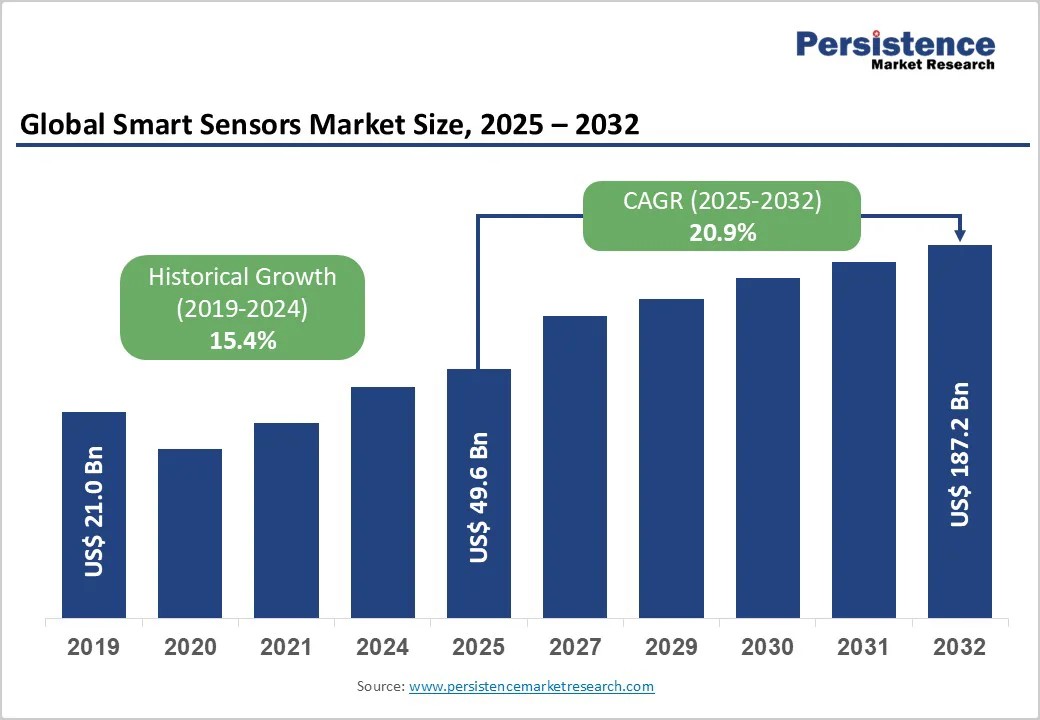
BRENTFORD, ENGLAND, UNITED KINGDOM, February 2, 2026 /EINPresswire.com/ -- The global smart sensors market is experiencing remarkable growth, driven by accelerating digital transformation and the widespread adoption of Internet of Things (IoT) technologies. Valued at US$49.6 billion in 2025, the market is projected to reach US$187.2 billion by 2032, registering a robust CAGR of 20.9% during the forecast period. The rising demand for intelligent sensing solutions is fueled by their critical role in enhancing automation, energy efficiency, and real-time data analytics across multiple sectors.
Motion sensors dominate the global market with over 32% share, primarily due to their integration in automotive Advanced Driver Assistance Systems (ADAS), robotics, and consumer electronics. North America leads the market with a 36% revenue share in 2025, benefiting from early IoT adoption, advanced semiconductor manufacturing capabilities, and strong Industry 4.0 initiatives. Meanwhile, the Asia Pacific region emerges as the fastest-growing market, propelled by China’s sensor manufacturing ecosystem, Japan’s automotive innovations, and India’s digital infrastructure expansion.
𝐆𝐞𝐭 𝐚 𝐒𝐚𝐦𝐩𝐥𝐞 𝐏𝐃𝐅 𝐁𝐫𝐨𝐜𝐡𝐮𝐫𝐞 𝐨𝐟 𝐭𝐡𝐞 𝐑𝐞𝐩𝐨𝐫𝐭: https://www.persistencemarketresearch.com/samples/24175
Key Highlights from the Report
North America leads the smart sensors market with 36% revenue share in 2025.
Asia Pacific is the fastest-growing region at a 22% CAGR.
Motion sensors dominate globally with over 32% market share.
MEMS-based sensors represent the fastest-growing technology segment.
Healthcare and wearable applications present significant growth opportunities.
The automotive sector is a primary driver of smart sensor adoption.
Market Segmentation
The smart sensors market is broadly segmented by product type, including motion sensors, optical sensors, temperature sensors, pressure sensors, and MEMS-based sensors. Motion sensors currently dominate due to their application in autonomous vehicles, industrial automation, and smart homes. MEMS-based sensors are gaining traction, owing to their miniaturized form factor, multi-sensor integration, and cost-effectiveness, making them ideal for wearable and IoT devices.
By end-user, the market spans automotive, healthcare, consumer electronics, industrial, and aerospace sectors. The automotive segment leads, driven by the surge in autonomous and connected vehicles, where motion and MEMS sensors are critical for safety and navigation. Healthcare is emerging as a high-growth segment, as biosensors, remote monitoring, and wearable technologies transform patient care and chronic disease management.
𝐃𝐨 𝐘𝐨𝐮 𝐇𝐚𝐯𝐞 𝐀𝐧𝐲 𝐐𝐮𝐞𝐫𝐲 𝐎𝐫 𝐒𝐩𝐞𝐜𝐢𝐟𝐢𝐜 𝐑𝐞𝐪𝐮𝐢𝐫𝐞𝐦𝐞𝐧𝐭? 𝐑𝐞𝐪𝐮𝐞𝐬𝐭 𝐂𝐮𝐬𝐭𝐨𝐦𝐢𝐳𝐚𝐭𝐢𝐨𝐧 𝐨𝐟 𝐑𝐞𝐩𝐨𝐫𝐭: https://www.persistencemarketresearch.com/request-customization/24175
Regional Insights
North America continues to dominate the smart sensors market, benefiting from early adoption of IoT-enabled infrastructure and advanced manufacturing technologies. The region’s automotive, aerospace, and industrial automation sectors are heavily investing in smart sensing solutions to improve efficiency and safety.
In contrast, the Asia Pacific region is the fastest-growing market, fueled by China’s strong manufacturing base, Japan’s automotive and robotics innovation, and India’s expanding digital infrastructure. Rapid urbanization and smart city initiatives further drive the adoption of smart sensors across industrial and consumer applications.
Market Drivers
The primary drivers for the smart sensors market include the expansion of IoT ecosystems, rising industrial automation, and the adoption of Industry 4.0 frameworks. The growing deployment of smart devices, connected vehicles, and automated production lines increases demand for high-precision sensors capable of real-time monitoring and predictive analytics. Additionally, rising environmental monitoring needs and energy efficiency mandates propel sensor adoption across residential, industrial, and commercial sectors.
Market Restraints
Despite strong growth, the market faces challenges such as high integration costs, technical complexity, and data privacy concerns. Limited standardization across sensor platforms and interoperability issues can hinder seamless deployment, particularly in industrial and smart city applications. Additionally, fluctuating raw material prices and supply chain disruptions pose potential restraints on market expansion.
Market Opportunities
Healthcare, wearables, and smart home applications offer significant growth opportunities for smart sensors. The rising adoption of telehealth, fitness tracking devices, and remote patient monitoring solutions is creating new avenues for sensor integration. Furthermore, advancements in MEMS technology, sensor miniaturization, and AI-driven analytics are enabling innovative applications in autonomous vehicles, industrial automation, and environmental monitoring.
𝐁𝐮𝐲 𝐍𝐨𝐰 𝐭𝐡𝐞 𝐃𝐞𝐭𝐚𝐢𝐥𝐞𝐝 𝐑𝐞𝐩𝐨𝐫𝐭: https://www.persistencemarketresearch.com/checkout/24175
Reasons to Buy the Report
✔ Comprehensive analysis of global and regional smart sensors markets.
✔ Detailed insights into market segmentation, including product type and end-user.
✔ Identification of key growth drivers, opportunities, and industry restraints.
✔ Strategic insights into emerging trends, innovations, and technological developments.
✔ Company profiles, competitive landscape, and recent market developments.
Frequently Asked Questions (FAQs)
How big is the smart sensors market globally?
Who are the key players in the global smart sensors market?
What is the projected growth rate of the smart sensors market?
What is the market forecast for smart sensors in 2032?
Which region is estimated to dominate the smart sensors industry through the forecast period?
Company Insights
Key Players Operating in the Market:
Bosch Sensortec GmbH
Texas Instruments Inc.
STMicroelectronics N.V.
Honeywell International Inc.
Infineon Technologies AG
Analog Devices, Inc.
NXP Semiconductors N.V.
TE Connectivity Ltd.
Recent Developments:
Bosch Sensortec launched a new line of MEMS-based environmental sensors for wearable and smart home applications in 2025.
Texas Instruments introduced an AI-enabled motion sensor platform for autonomous vehicles and robotics, enhancing real-time data processing capabilities.
Related Reports:
Free Standing Display Units Market
Test Socket Thermal Solutions Market
Pooja Gawai
Persistence Market Research
+1 646-878-6329
email us here
Visit us on social media:
LinkedIn
Instagram
Facebook
YouTube
Legal Disclaimer:
EIN Presswire provides this news content "as is" without warranty of any kind. We do not accept any responsibility or liability for the accuracy, content, images, videos, licenses, completeness, legality, or reliability of the information contained in this article. If you have any complaints or copyright issues related to this article, kindly contact the author above.
