

Water-Saving Cleaning Chemicals Market Report 2026-2036: High-Value Insights for Strategy, Product Development
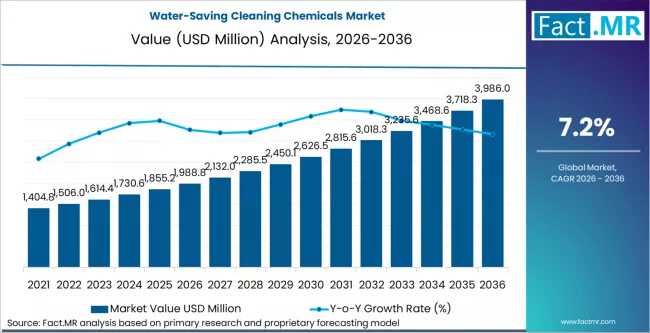
Water-Saving Cleaning Chemicals Market
Global Water-Saving Cleaning Chemicals Market Set to Surpass $207 Billion by 2026 Amid Rising Industrial Water Scarcity
ROCKVILLE, MD, UNITED STATES, January 30, 2026 /EINPresswire.com/ -- As global industries face tightening environmental mandates and freshwater shortages, the shift toward water-efficient cleaning formulations is transforming the $170 billion global landscape into a highly specialized high-growth sector.The global water-saving and sustainable cleaning chemicals market is entering a pivotal expansion phase, projected to reach $207 billion by late 2026. Driven by a convergence of industrial water-reuse mandates and a surge in bio-based low-rinse technologies, the sector is moving beyond simple green claims toward high-performance, water-neutral operations.
Request for Sample Report | Customize Report |purchase Full Report - https://www.factmr.com/connectus/sample?flag=S&rep_id=14014
Who is Driving the Market?
The market’s momentum is spearheaded by chemical giants and specialty innovators, including Ecolab Inc., BASF SE, Solenis, and Dow Inc. These entities are pivoting from traditional high-volume surfactants to concentrated, enzyme-based, and dry cleaning solutions. Key adoption is concentrated in the Asia-Pacific region—which currently holds a dominant 40% market share—and water-stressed industrial hubs in North America and Europe.
What is Changing?
The core of the market is shifting from conventional detergents to Water-Saving Cleaning Chemicals. These include:
Ready-to-Use (RTU) Concentrates: Solutions like Ecolab’s ReadyDose that minimize the water required for dilution and transport.
Bio-based Surfactants: Derived from renewable sources that break down faster and require 30-50% less rinse water than synthetic alternatives.
Smart-Dosing Systems: IoT-integrated chemical dispensers that use real-time sensors to optimize chemical intensity, reducing overall water consumption by nearly 20% in industrial laundry and food processing sectors.
When and Where is Growth Occurring?
With the forecast period extending through 2034, the most significant acceleration is expected between 2025 and 2026. Geographically, India and China remain the fastest-growing markets, fueled by Zero-Liquid-Discharge (ZLD) mandates in the textile and pharmaceutical sectors. In the United States, the market is valued at approximately $1.16 billion for specialized water-treatment and cleaning chemistries as of 2026, driven by infrastructure upgrades and the Jal Jeevan-style utility projects globally.
Why the Shift?
The transition is no longer optional. Industrial facilities are facing:
Strict Discharge Norms: New regulations on PFAS and residual chlorine are forcing a move toward biodegradable alternatives like peracetic acid and enzyme-based degreasers.
Resource Scarcity: With agriculture and industrial activities consuming over 70% of global freshwater, water-neutral cleaning has become a key ESG (Environmental, Social, and Governance) metric for investors and analysts.
Operational Efficiency: Concentrated formulas reduce plastic waste by up to 98% and lower logistics costs, providing a tangible ROI for the hospitality and healthcare sectors.
How it Works
Unlike traditional cleaning agents that rely on high-volume water flushing to remove chemical residue, modern water-saving chemicals utilize surfactant-enhanced coagulation and high-performance chelating agents. These technologies allow soils to be suspended and removed with minimal moisture, often incorporating no-rinse properties that are safe for food-contact surfaces and medical environments.
Market Outlook: 2026 and Beyond
The Industrial and Institutional (I&I) cleaning segment is poised for a CAGR of 8.75%, with sustainable products expected to make up over 52.7% of the total market by the end of 2026. As the industry moves toward a circular economy, the integration of digital monitoring and bio-based chemistry will remain the primary competitive differentiator.
The industry is moving from 'clean at any cost' to 'precision hygiene,' says a leading industry analyst. The 2026 horizon marks the point where water-saving performance becomes the standard, not the specialty.
About the Report This press release is based on integrated market data reflecting the 2021–2034 forecast period, focusing on global chemical production trends, sustainability metrics, and industrial water-management strategies.
Related Reports
Cleaning Fluids Market https://www.factmr.com/report/cleaning-fluids-market
Self-cleaning Glass Market https://www.factmr.com/report/self-cleaning-glass-market
Lens Cleaning Product Market https://www.factmr.com/report/2522/lens-cleaning-products-market
Metal Cleaning Chemicals Market https://www.factmr.com/report/5370/metal-cleaning-chemicals-market
S. N. Jha
Fact.MR
+1 628-251-1583
email us here
Legal Disclaimer:
EIN Presswire provides this news content "as is" without warranty of any kind. We do not accept any responsibility or liability for the accuracy, content, images, videos, licenses, completeness, legality, or reliability of the information contained in this article. If you have any complaints or copyright issues related to this article, kindly contact the author above.
