

2036 Strategic Analysis of the Disinfectant Fogging and Misting Chemicals Market: Portfolio Priorities
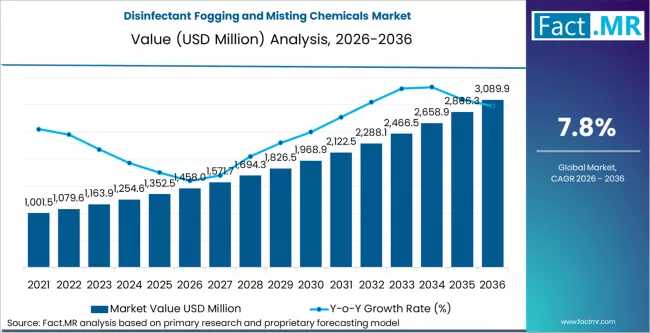
Disinfectant Fogging and Misting Chemicals Market
Global Disinfectant Fogging and Misting Chemicals Market Set for Rapid Expansion Through 2026 as Public Health Infrastructure Evolves
ROCKVILLE, MD, UNITED STATES, January 30, 2026 /EINPresswire.com/ -- The global Disinfectant Fogging and Misting Chemicals Market is entering a transformative growth phase in 2026, driven by a fundamental shift in how public and private sectors approach environmental hygiene. As organizations move beyond reactive cleaning toward proactive, large-scale microbial control, the demand for specialized chemical formulations—optimized for aerosolization—is reaching unprecedented levels.The Shift Toward No-Touch Sanitization
Disinfectant fogging and misting involve the dispersion of antimicrobial chemicals in the form of ultra-fine droplets, typically ranging from 5 to 50 microns. This method, often referred to as no-touch disinfection, allows for the uniform treatment of entire volumes of air and complex surface geometries that manual wiping often misses.
Recent market data indicates that the broader surface disinfectant sector is projected to reach approximately $6.45 billion by the end of 2026, growing at a compound annual growth rate (CAGR) of nearly 12%. Within this landscape, the air disinfection and chemical misting segment is identified as the fastest-growing application, as facility managers across healthcare, hospitality, and transportation prioritize speed and comprehensive coverage.
Request for Sample Report | Customize Report |purchase Full Report - https://www.factmr.com/connectus/sample?flag=S&rep_id=14005
Market Dynamics: Who, What, and Why
Who is driving the market? Key stakeholders include healthcare administrators, commercial facility managers, and professional pest control operators. Industry leaders such as Ecolab, Reckitt Benckiser, and The Clorox Company are leading the charge in formulating fog-ready chemicals.
What chemicals are dominating? While Alcohols maintain a significant 41% share of the general market, the fogging niche is seeing a surge in Quaternary Ammonium Compounds (QACs) and Hydrogen Peroxide (H2O2) due to their stability and efficacy in vaporized forms.
Where is the growth happening? North America currently commands nearly 50% of the market share, supported by stringent OSHA and EPA standards. However, the Asia-Pacific region is the fastest-growing market, fueled by rapid urbanization and government-led hygiene initiatives in India and China.
Why the sudden surge? The primary catalysts are the rising incidence of Healthcare-Associated Infections (HAIs) and the permanent integration of advanced sanitation protocols into corporate ESG (Environmental, Social, and Governance) strategies.
Technical Evolution: From Chlorine to Eco-Friendly Mists
The industry is witnessing a significant pivot toward sustainability. Traditional chlorine-based solutions are increasingly being supplemented—or replaced—by bio-based, non-toxic alternatives.
The integration of nanotechnology and plant-derived chemistries is no longer a niche trend; it is a regulatory and consumer requirement, states a leading industry analyst. In 2026, the focus has shifted from mere 'kill-claims' to the safety profile and environmental footprint of the aerosolized particles.
The rise of Electrostatic Spraying Technology has also revolutionized chemical demand. These systems charge the mist particles, allowing them to wrap around surfaces and cling to the undersides of furniture, necessitating chemicals with specific conductivity and dwell-time profiles.
Sector-Specific Applications
Healthcare: Hospitals remain the largest end-users, utilizing Vaporized Hydrogen Peroxide (VHP) for terminal cleaning of operating rooms.
Food & Beverage: Misting systems are critical in processing plants to prevent cross-contamination and manage listeria or salmonella risks.
Commercial Real Estate: Large-scale office complexes and airports are adopting automated fogging schedules to maintain high indoor air quality (IAQ) and worker confidence.
Future Outlook and Economic Impact
Despite challenges such as fluctuating raw material costs and regional tariffs on alcohol-based formulations, the market outlook remains robust. The 2026 chemical industry landscape suggests that companies prioritizing portfolio rebalancing toward specialty low-drift and rapid-action fogging agents will capture the highest profit margins.
As the industry moves toward 2036, the convergence of Artificial Intelligence (AI) and automated fogging hardware is expected to further optimize chemical usage, reducing waste while ensuring that disinfection levels meet the rigorous standards of modern public health.
To View Related Report :
Related Reports
Disinfectant & Antimicrobial Chemicals Market https://www.factmr.com/report/4218/disinfectant-antimicrobial-chemicals-market
Salon Disinfectants Market https://www.factmr.com/report/1784/salon-disinfectants-market
Veterinary Disinfectants Market https://www.factmr.com/report/5000/veterinary-disinfectants-market
Sterilant and Disinfectant Chemicals Market https://www.factmr.com/report/4701/sterilant-and-disinfectant-chemicals-market
S. N. Jha
Fact.MR
+1 628-251-1583
email us here
Legal Disclaimer:
EIN Presswire provides this news content "as is" without warranty of any kind. We do not accept any responsibility or liability for the accuracy, content, images, videos, licenses, completeness, legality, or reliability of the information contained in this article. If you have any complaints or copyright issues related to this article, kindly contact the author above.
