

Positron Emission Tomography Imaging Market Grows at 5.3% CAGR Through 2033 | Persistence Market Research
Positron Emission Tomography (PET) imaging market
The global PET imaging market is expanding, driven by advancements in diagnostics, increasing disease prevalence, and growing demand in oncology and neurology.
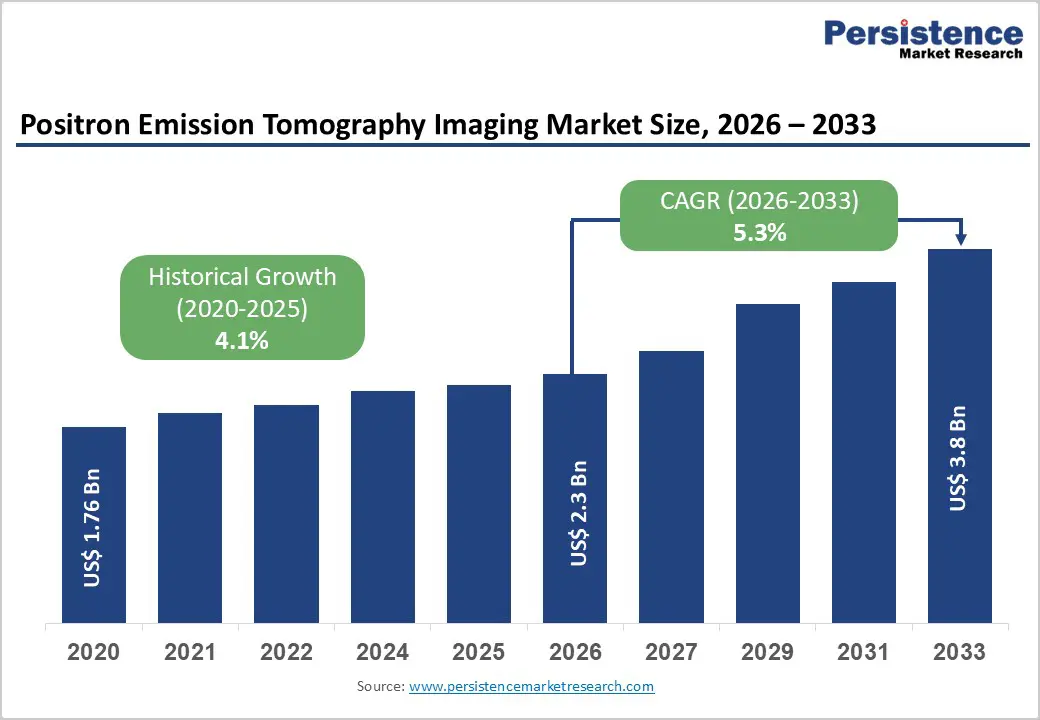
LONDON, UNITED KINGDOM, January 28, 2026 /EINPresswire.com/ -- The global Positron Emission Tomography (PET) imaging market is experiencing significant growth, with its size expected to increase from US$ 2.3 billion in 2026 to US$ 3.8 billion by 2033. This growth represents a compound annual growth rate (CAGR) of 5.3% from 2026 to 2033, driven by increasing demand for early and precise diagnostic tools, particularly in oncology, neurology, and cardiology.
Download Your Free Sample & Explore Key Insights: https://www.persistencemarketresearch.com/samples/36033
Market Drivers
The rise in the global prevalence of chronic diseases, such as cancer, neurological disorders, and cardiovascular diseases, is a key driver for the PET imaging market. According to the Alzheimer’s Association, by 2025, over 7.2 million Americans over 65 will have Alzheimer’s, underscoring the growing burden of neurodegenerative diseases in aging populations. As such, PET imaging plays a critical role in early disease detection, therapy selection, and monitoring treatment responses, making it indispensable in oncology and neurology.
Technological advancements, such as hybrid PET/CT and PET/MRI systems, AI-enabled image reconstruction, and high-resolution digital detectors, are enhancing image quality and reducing scan times. These innovations improve diagnostic accuracy and workflow efficiency, further boosting PET adoption. Additionally, the development of novel radiotracers enables more targeted diagnostics, thus expanding the clinical applications of PET imaging across different medical specialties.
Key Market Trends and Product Segmentation
North America dominates the global PET imaging market, holding approximately 47.5% of the market share, driven by advanced healthcare infrastructure, high diagnostic imaging volumes, and favorable reimbursement policies. The region also leads in the early adoption of innovative PET technologies, including AI-driven imaging analytics and theranostic applications. In contrast, the Asia Pacific region is emerging as the fastest-growing market, with a projected CAGR of 7.2% from 2026 to 2033. Rising cancer incidences, expanding diagnostic infrastructures, and government initiatives to improve healthcare systems are key factors propelling the growth of PET imaging in the region.
In terms of product segmentation, full-ring PET scanners dominate the market due to their superior sensitivity, higher resolution, and ability to conduct whole-body imaging. These systems are widely used in oncology, cardiology, and neurology settings, particularly in large hospitals and research institutions. On the other hand, partial-ring PET scanners are gaining traction as cost-effective alternatives for outpatient diagnostic centers and emerging markets seeking affordable yet efficient imaging solutions.
Get Custom Insights Designed for Your Business: https://www.persistencemarketresearch.com/request-customization/36033
Application Segmentation: Oncology Leads, Neurology Grows Rapidly
Oncology remains the largest application segment, accounting for over 40% of the market revenue. PET imaging plays an indispensable role in cancer diagnosis, staging, treatment planning, and monitoring therapy responses. It provides functional and metabolic insights into tumors, allowing clinicians to assess tumor aggressiveness and detect metastases with greater precision than traditional imaging modalities. With the increasing global cancer incidence and the adoption of personalized treatment strategies, the demand for PET in oncology continues to grow.
Restraints: High Costs and Regulatory Challenges
Despite the robust growth, the PET imaging market faces significant challenges, particularly in the form of high capital and operational costs. The initial investment in PET scanners, specialized infrastructure, and maintenance costs can be prohibitively expensive for smaller healthcare facilities, limiting the adoption of PET systems, particularly in emerging markets. Moreover, the need for highly trained professionals and the cost of radiopharmaceuticals further contribute to the financial burden.
Opportunities: Technological Innovation and Theranostics
Technological innovation presents significant opportunities in the PET imaging market. Artificial intelligence (AI) is transforming PET imaging by improving image reconstruction, automating lesion detection, and optimizing workflow efficiency. AI algorithms are also enhancing diagnostic accuracy and reducing variability in image interpretation, which improves clinical decision-making and operational efficiency.
Competitive Landscape and Key Players
The PET imaging market is highly competitive, with leading players such as Siemens Healthineers, GE Healthcare, United Imaging Healthcare, and Bruker, competing on technological advancements, product offerings, and global market reach. These companies are focusing on improving the sensitivity, accuracy, and speed of PET scanners, as well as integrating AI and machine learning technologies to enhance imaging capabilities. Strategic collaborations with radiopharmaceutical developers and research institutions are also common, as companies aim to expand their portfolios and improve access to innovative diagnostic solutions.
Checkout Now & Download Complete Market Report: https://www.persistencemarketresearch.com/checkout/36033
Market Segmentation
By Product
Full-Ring PET Scanners
Partial Ring PET Scanners
By Application
Oncology
Neurology
Cardiology
Others
By End-user
Hospitals
Ambulatory Surgery Centers
Diagnostic Imaging Centers
Others
By Region
North America
Europe
East Asia
South Asia and Oceania
Latin America
Middle East and Africa
Regional Insights and Future Outlook
North America remains the largest market for PET imaging, primarily due to its robust healthcare infrastructure and early adoption of advanced imaging technologies. The U.S. also benefits from strong reimbursement frameworks and a high prevalence of chronic diseases, which drive the demand for diagnostic imaging.
In Europe, the PET imaging market is growing steadily, supported by well-developed healthcare systems, an aging population, and increasing cancer and neurodegenerative disease rates. In Asia Pacific, the market is expected to see rapid growth, fueled by improvements in healthcare infrastructure, rising awareness of early disease detection, and increasing access to advanced diagnostic tools.
Read Related Reports:
Laboratory Developed Testing Market: The Laboratory Developed Testing Market will grow from $9.0Bn (2025) to $13.9Bn (2032) at a 6.4% CAGR, with clinical biochemistry tests holding a 34.2% share.
Intracranial Therapeutic Delivery Market: Intracranial therapeutic delivery market reaches US$4.2 Bn by 2032, supported by innovation in drug delivery systems and rising prevalence of neurological disorders.
Persistence Market Research
Persistence Market Research Pvt Ltd
+1 646-878-6329
email us here
Visit us on social media:
LinkedIn
Instagram
Facebook
YouTube
X
Legal Disclaimer:
EIN Presswire provides this news content "as is" without warranty of any kind. We do not accept any responsibility or liability for the accuracy, content, images, videos, licenses, completeness, legality, or reliability of the information contained in this article. If you have any complaints or copyright issues related to this article, kindly contact the author above.
